
Table of Contents
- What Is a Virtual Doctor for Hormonal Imbalance?
- Common Symptoms of Hormonal Imbalance Men Often Miss
- How to Prepare for a Hormone Health Appointment
- The Diagnostic Process: Lab Testing and Clinical Assessment
- What to Ask Your Endocrinologist Online
- Cost of Virtual Hormone Therapy and Insurance Considerations
- Personalized Treatment Plans and Follow-Up Monitoring
- Conclusion
Last Updated: August 14, 2026
What Is a Virtual Doctor for Hormonal Imbalance?
A virtual doctor for hormonal imbalance is a telehealth physician who diagnoses and treats hormone-related conditions through remote video consultations, lab testing, and personalized treatment plans, without requiring in-person office visits. This approach combines clinical assessment with a lab-first methodology to identify underlying hormonal issues that traditional primary care doctors often overlook.
At Socal Mens Clinic Virtual, we’ve found that many men arrive with years of fatigue, brain fog, and declining performance, only to hear from their regular doctor that their testosterone levels are "normal." The problem isn’t that the numbers are wrong, it’s that the reference ranges used by standard labs don’t account for how you feel or how you perform. A virtual doctor for hormonal imbalance uses more nuanced diagnostic criteria and ongoing monitoring to catch what gets missed.
The virtual model removes friction. You don’t need time off work, lobby waits, or insurance referral mazes. Instead, you complete lab work at a local LabCorp facility, upload your results, and consult with a licensed physician who reviews your full picture, symptoms, lifestyle, bloodwork, and goals, to create a treatment strategy tailored to your biology.
The key difference between a virtual doctor for hormonal imbalance and your regular doctor: specialized endocrinology training plus a willingness to treat based on symptom relief and functional improvement, not just hitting arbitrary lab reference ranges. This distinction matters enormously for men in their 40s and 50s experiencing midlife hormone shifts.
Common Symptoms of Hormonal Imbalance Men Often Miss
Most men don’t connect their symptoms to hormones. They assume fatigue, weight gain despite exercise, muscle loss, mood changes, and erectile dysfunction are just "part of getting older." That’s the first mistake.
Persistent low energy that coffee doesn’t fix is a hallmark sign. You wake up tired and stay tired through the afternoon, even after a full night’s sleep. This often signals low testosterone, thyroid dysfunction, or elevated cortisol from chronic stress.
Brain fog is another red flag people dismiss. You struggle to focus on complex tasks, forget names mid-conversation, or lose your train of thought in meetings. It’s frequently tied to low testosterone, thyroid dysfunction, or elevated cortisol.
Weight management becomes mysteriously difficult. You’re active and mindful of diet, but the scale won’t budge or you’re gaining fat despite maintaining your fitness routine. Meanwhile, you’re losing muscle tone even though you’re still lifting weights. This pattern, fat gain plus muscle loss, is classic hormonal imbalance, particularly low testosterone combined with insulin resistance.
Sexual performance changes are often the wake-up call. Erectile dysfunction, reduced libido, or difficulty maintaining arousal aren’t just psychological. They’re frequently the first visible sign of declining testosterone or poor vascular health tied to metabolic dysfunction.
Sleep disturbances show up as insomnia, night sweats, or restless sleep despite exhaustion. These often signal cortisol dysregulation, thyroid imbalance, or hormonal fluctuations.
Mood changes, irritability, anxiety, depression, or emotional flatness, are frequently hormonal. Low testosterone correlates strongly with depression and anxiety in men.
The biggest mistake: waiting until multiple symptoms stack up before seeking help. By the time you’re experiencing fatigue and muscle loss and ED and mood changes, your hormonal imbalance has likely been developing for months or years. Early intervention is far easier than recovery from advanced decline.
How to Prepare for a Hormone Health Appointment
Preparation determines the quality of your virtual doctor for hormonal imbalance consultation. A well-prepared appointment yields accurate diagnosis and a treatment plan that actually addresses your situation.
Start by documenting your symptoms with specificity. Don’t just think "I’m tired", write down when fatigue hits hardest (morning, afternoon, after meals), what makes it better or worse, and how it’s changed over the past 6-12 months. Same with sexual function: note frequency of difficulty, whether it’s consistent or situational, and how long this has been happening. Symptom specificity helps your physician connect the dots between your bloodwork and how you actually feel.

Gather your medical history. Write down any previous blood tests, especially testosterone, thyroid panels (TSH, Free T4, Free T3), or metabolic panels. Bring actual results if you have them; reference ranges vary between labs. List any medications you’re taking, including over-the-counter supplements. Note any previous diagnoses, surgeries, or conditions that might affect hormones (diabetes, thyroid disease, sleep apnea, high blood pressure).
Prepare a lifestyle inventory. Document your typical sleep schedule, exercise routine (frequency, type, intensity), stress level and management, and diet patterns. Include alcohol consumption and any substance use. Hormones are shaped by sleep, training, nutrition, and stress. Your virtual doctor for hormonal imbalance needs this context.
Write down your goals. What do you want to improve? More energy? Better sexual function? Muscle growth? Weight loss? Clearer thinking? Mental stability? Be honest about what matters to you. Your treatment plan will prioritize these outcomes.
The most valuable preparation is a symptom timeline: when did each issue start, how has it progressed, and what (if anything) made it better or worse? This narrative is often more diagnostic than any single lab value.
The Diagnostic Process: Lab Testing and Clinical Assessment
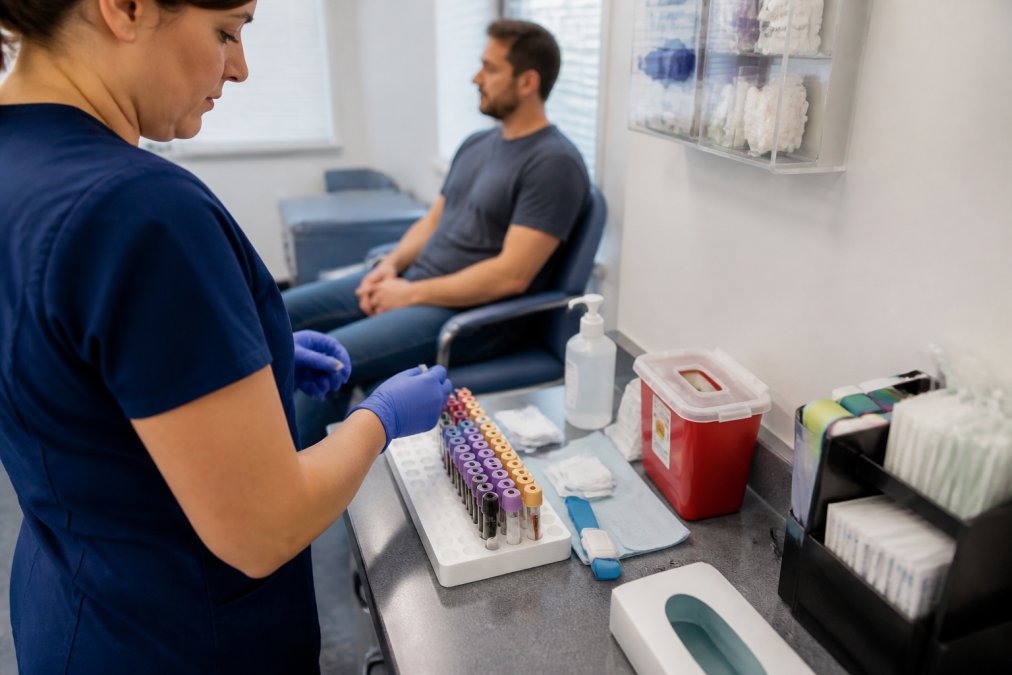
Virtual hormone consultations begin with comprehensive lab testing. Your virtual doctor for hormonal imbalance won’t rely on a single testosterone number. Instead, you’ll get a full endocrine panel: total testosterone, free testosterone, estradiol, DHEA-S, thyroid function (TSH, Free T4, Free T3), cortisol, prolactin, and often additional markers like insulin, fasting glucose, and lipid panels depending on your symptoms.
The lab-first approach removes guesswork. You go to LabCorp or a local draw site, provide blood samples, and within 5-7 business days, your results are available for clinical review. This is faster and more accessible than waiting for an endocrinologist referral through insurance.
Your virtual doctor for hormonal imbalance interprets these results in context. They’re not just checking if your testosterone is above or below the lab’s reference range; they’re assessing whether your levels explain your symptoms and whether they’re optimal for your age, fitness level, and goals. A 50-year-old man with a testosterone level of 400 ng/dL might be technically "normal" by standard reference ranges, but if he’s experiencing fatigue and muscle loss, that number may be functionally low for his situation.
The clinical assessment happens during your video consultation. Your physician reviews your symptom history, asks detailed follow-up questions about onset and severity, and connects the clinical picture to your lab results. They’ll ask about your training regimen, sleep quality, stress, diet, and sexual function. They may order additional tests if needed.
The diagnostic process typically takes 1-2 weeks from initial lab work to your first consultation.
What to Ask Your Endocrinologist Online
Knowing what to ask your endocrinologist online ensures you get actionable answers, not vague reassurance.
Start with the root cause: "Based on my labs and symptoms, what’s driving my hormonal imbalance? Is it primary (my body isn’t producing enough) or secondary (something else is suppressing production)?" This distinction matters because treatment differs.
Ask about your specific lab values: "My testosterone is X, and the reference range is Y-Z. Why do you think I’m experiencing these symptoms at this level? What would be an optimal range for my goals?" This prevents the "you’re in range" dismissal.
Clarify the treatment plan: "What’s the proposed treatment, how does it work, and what should I expect to feel in week 1, week 4, and week 12?" Vague answers are a red flag. Good practitioners give you a timeline and specific milestones.
Ask about monitoring: "How often will we recheck labs? What metrics are we tracking to know if this is working? When should I contact you if something feels off?"
Discuss side effects and risks: "What are the realistic side effects I might experience? How common are they? What’s the protocol if I experience them?"
Ask about your role: "What should I be doing on my end, sleep, exercise, nutrition, to optimize results? Are there things I should avoid?"
The question that separates competent practitioners from great ones: “If this treatment isn’t working after 8-12 weeks, what’s our backup plan?” Practitioners who have a clear answer are thinking long-term about your health.
Cost of Virtual Hormone Therapy and Insurance Considerations
Most virtual practices, including Socal Mens Clinic Virtual, operate on a direct-pay model rather than insurance billing. You pay out of pocket for consultations, lab work, and medications. The advantage is speed and simplicity: no insurance approval delays, no referral requirements, no fighting about what’s "medically necessary."
The cost structure typically includes a consultation fee, lab testing fees, and ongoing medication costs. Many practices bundle these into a monthly membership or package to simplify budgeting.
The key question: "Why would I pay out of pocket when I have insurance?" If your insurance plan covers endocrinology and you’re comfortable waiting 4-8 weeks for a referral, using your insurance might make sense. But if your insurance has high deductibles, limited specialist coverage, or slow approval processes, direct-pay care often costs less in total time and money. Additionally, insurance-based care creates a permanent record that may affect future coverage or rates. Direct-pay care is private.
Many men find that the direct-pay model is worth it because it’s faster, more discreet, and gives them access to practitioners who specialize in men’s health optimization.
For specific pricing and current package options, visit Socal Mens Clinic Virtual’s website to see what fits your budget and needs.
The insurance vs. direct-pay decision hinges on three factors: speed (how quickly do you need care?), cost (what’s your total out-of-pocket exposure?), and privacy (do you want this on your insurance record?). Direct-pay typically wins on speed and privacy; insurance might win on cost if your plan has good specialist coverage.
Personalized Treatment Plans and Follow-Up Monitoring
A personalized treatment plan for hormonal imbalance is built on your specific lab results, symptoms, and goals, not a standard protocol applied to everyone.
If your diagnostics show low testosterone, your plan might include testosterone replacement therapy (TRT) via injection, gel, or pellet depending on your preference and lifestyle. If your thyroid is underactive, you might get thyroid hormone replacement. If your cortisol is dysregulated, your plan might focus on sleep optimization, stress management, and sometimes supplemental support. If you have insulin resistance driving metabolic dysfunction, your treatment might include medication plus nutrition and exercise changes.
The best plans address multiple hormonal systems simultaneously. A man with low testosterone and elevated cortisol and poor sleep needs a strategy that tackles all three. This is where a virtual doctor for hormonal imbalance with endocrinology training makes a difference, they see the interconnections.
Follow-up monitoring is where personalized care becomes obvious. Most quality practitioners recheck labs 4-6 weeks after starting treatment to assess response and adjust dosing based on how you feel and how your labs respond. If you’re not seeing expected improvement, they investigate why: compliance, absorption, dosing, or whether the diagnosis was incomplete.
Ongoing monitoring typically happens every 8-12 weeks initially, then quarterly once you’re stable. Your virtual doctor for hormonal imbalance should be accessible between appointments if you have questions or concerns.
The goal isn’t just to get your numbers into range; it’s to get you feeling and performing like yourself again. A good practitioner tracks both objective metrics (lab values, body composition, strength) and subjective ones (energy, mood, sexual function, cognitive clarity). If the numbers look good but you still feel terrible, your plan adjusts. If you feel great but the labs suggest risk, your plan adjusts.
Hormonal imbalance doesn’t have to be a permanent part of aging. A virtual doctor for hormonal imbalance can identify what’s driving your fatigue, weight gain, and declining performance, and create a treatment strategy based on your unique biology. Socal Mens Clinic Virtual combines licensed California physicians with a lab-first diagnostic approach and ongoing medical support to help you reclaim your energy, muscle, sexual function, and mental clarity. The process is straightforward: prepare your symptom history, complete lab testing, consult with a specialist, and follow a personalized treatment plan with regular monitoring. If you’re tired of dismissive "you’re normal" responses from your regular doctor, it’s time to explore what precision hormone care can do. Get started with Socal Mens Clinic Virtual today and discover whether hormonal optimization is the missing piece in your health.
Frequently Asked Questions
What type of doctor should I see for hormonal imbalance?
An endocrinologist specializes in the endocrine system and hormone disorders, making them the ideal choice. However, primary care physicians and men's health specialists trained in hormone replacement therapy can also diagnose and treat hormonal imbalance. A virtual doctor with a lab-first approach uses blood panels to measure specific hormone levels, cortisol, testosterone, thyroid markers, then creates a personalized care plan based on your results. The key is finding a physician-led telehealth platform that conducts thorough diagnostic evaluation rather than offering cookie-cutter treatment.
What are the 5 signs of hormonal imbalance I shouldn't ignore?
Persistent fatigue despite adequate sleep, unexplained weight gain or difficulty losing weight, declining muscle mass and strength, mood changes including depression or irritability, and sexual dysfunction or low libido are five critical warning signs. Men often dismiss these as normal aging, but hormonal imbalance is treatable. If your regular doctor dismissed your symptoms as 'normal,' a virtual hormone consultation with lab testing can identify specific deficiencies your standard checkup may have missed.
How does virtual hormone therapy differ from in-person endocrinology?
Virtual hormone consultations offer the same diagnostic rigor as in-person visits but with convenience and privacy. You complete a health questionnaire, provide lab work (often through LabCorp), and meet your physician via secure video. The physician reviews your blood panel, discusses your symptoms, and develops a personalized treatment plan. Follow-up monitoring happens remotely through your patient portal. The main difference: no waiting room, flexible scheduling, and direct access to your medical records, all without the insurance complexity.
Can I trust a virtual doctor to actually find what my regular doctor missed?
Yes, if the platform uses a lab-first approach with comprehensive blood panels. Many primary care physicians order only basic testosterone or thyroid screening, missing markers like cortisol levels, insulin resistance, or adrenal function. Virtual endocrinology platforms designed for hormone optimization order more detailed diagnostic panels and spend time interpreting results in the context of your specific symptoms. This targeted clinical assessment, combined with physician-led follow-up, often identifies imbalances standard checkups overlook.
This article was written using GrandRanker