
Table of Contents
- Why Primary Care Misses Low Testosterone: The Diagnostic Reality
- The Normalization Bias in Primary Care
- Testosterone Blood Test Timing and Why It Matters
- How to Talk to Your Doctor About Low Testosterone
- Circadian Rhythm and Lifestyle Variability in Hormone Testing
- When to See an Endocrinologist for Low T
- Insurance and Diagnostic Barriers
- Conclusion: Taking Control of Your Testosterone Health
Last Updated: August 16, 2026
Why Primary Care Misses Low Testosterone: The Diagnostic Reality
Primary care physicians encounter thousands of patients annually complaining of fatigue, weight gain, and declining libido, yet many walk out with a clean bill of health despite genuine hormone problems. The issue isn’t physician incompetence, it’s that primary care is reactive rather than proactive, reliant on reference ranges that ignore individual variation, and constrained by time pressures that discourage deeper investigation.
At Socal Mens Clinic Virtual, we’ve analyzed this gap extensively. When a patient reports fatigue, a primary care doctor typically runs a single testosterone test, compares it to a broad population reference range, and moves on. This approach misses how testosterone actually works in the human body.
The challenge is compounded by normalization bias: the tendency for both patients and physicians to accept gradual hormone decline as natural aging rather than a treatable condition. A man whose testosterone dropped from 650 ng/dL at age 35 to 380 ng/dL at age 55 has experienced a 42% decline in his own baseline, yet he technically falls within the "normal" range for his age. His doctor sees the number and assumes nothing is wrong.
Understanding why primary care misses low testosterone requires examining the specific diagnostic, systemic, and behavioral factors that create blind spots.
The Normalization Bias in Primary Care
Testosterone naturally declines roughly 1% per year after age 30. Medical reference ranges account for this by providing age-adjusted "normal" values. A testosterone level of 350 ng/dL might be normal for a 70-year-old but low for a 40-year-old. This logic seems sound but creates a dangerous assumption: that any decline within the age-adjusted range is acceptable.
This ignores individual baseline variation. A man whose natural testosterone at age 25 was 750 ng/dL has experienced a significant biological shift if he’s now at 400 ng/dL at age 50, even if 400 is "normal" for his age group. His body has lost 47% of its testosterone production. Yet because the number falls within the reference range, it gets flagged as fine.
Primary care doctors don’t have time to dig into a patient’s lifetime hormone trajectory. They see a number, check it against a reference range, and move to the next patient. The system itself validates this approach. A man experiencing real symptoms of hormone decline walks away thinking either his symptoms are psychosomatic or that decline is inevitable.
The bias also affects symptom interpretation. Fatigue, weight gain, and low libido are attributed to stress, poor sleep, or lack of exercise, all real factors, but often secondary effects of declining testosterone, not primary causes.
Request your [actual testosterone values](/how-to-interpret-your-labcorp-blood-test-results/) from your primary care doctor, not just whether they’re “normal.” Ask specifically for total testosterone, free testosterone, and bioavailable testosterone. Write down the numbers and compare them to your own baseline from previous years. This gives you concrete data to discuss rather than relying on your doctor’s interpretation of a reference range.
Testosterone Blood Test Timing and Why It Matters
Testosterone levels fluctuate dramatically throughout the day. This circadian rhythm is one of the most important factors in accurate testosterone testing, and it’s where primary care screening often fails.
Testosterone peaks in the early morning, typically between 6 and 8 AM, and declines steadily throughout the day. A man tested at 8 AM might have a total testosterone of 550 ng/dL. The same man tested at 3 PM could show 420 ng/dL, a 23% difference from the same biological system on the same day.
Most primary care offices don’t test for testosterone in the early morning. Patients schedule appointments based on availability, often in late morning or afternoon. A man with genuinely low testosterone might get tested at 2 PM, when his levels are naturally suppressed, and fall just barely within the normal range. Retested at 8 AM, he’d be clearly low. But that retest rarely happens because the first result was "normal."
The American Association of Clinical Endocrinologists recommends morning blood draws specifically because of this circadian variation. Yet many primary care practices don’t follow this guideline. There’s also the matter of fasting status. Testosterone testing should ideally occur after overnight fasting, as glucose ingestion can temporarily suppress testosterone levels.
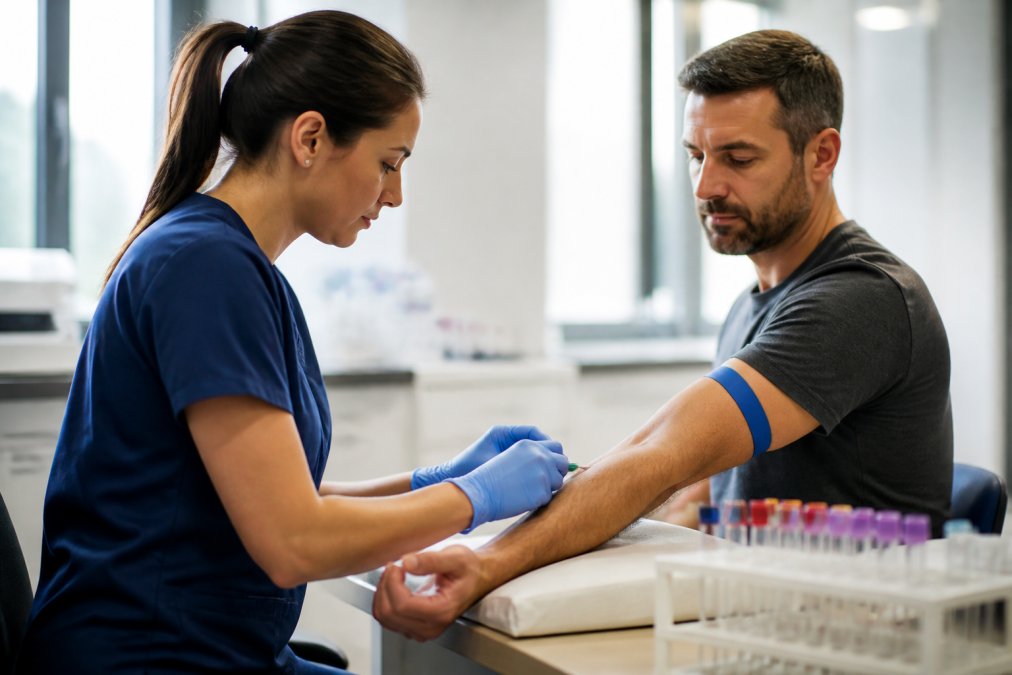
If your primary care doctor ordered a testosterone test but didn’t specify early morning timing, ask for a retest done between 7 and 9 AM after fasting overnight. The difference can be substantial enough to change the clinical interpretation. A single afternoon test is insufficient for diagnosis.
How to Talk to Your Doctor About Low Testosterone
The conversation between a patient and his primary care doctor about testosterone often breaks down because of misaligned expectations. Your doctor is trained to treat disease, not optimize hormones. If your testosterone is technically within the reference range, your doctor may not see it as a medical problem.
Start with specific symptoms, not hormone numbers. Instead of saying "I think I have low testosterone," say "I’ve noticed I’m gaining weight around my midsection despite exercising four times a week. My energy crashes by 3 PM most days, and my sex drive has declined noticeably over the past two years." Specific symptoms give your doctor something concrete to address.

Bring a timeline. If you have previous testosterone measurements, bring those numbers. If not, describe the trajectory: "My energy levels were significantly higher five years ago" or "I used to recover from workouts much faster." This gives context for why a "normal" number might represent a significant decline for you personally.
Ask specifically for a morning testosterone test. Don’t leave it to your doctor’s discretion. Say: "I’d like a testosterone test done in the early morning, ideally between 7 and 9 AM, after fasting overnight." Request the actual numbers, not just whether they’re normal. Ask for total testosterone, free testosterone, and sex hormone-binding globulin. Write them down and ask what the reference range is for your age.
If your doctor runs the test and comes back with results in the low-normal range but you’re experiencing clear symptoms, ask about a follow-up test or a referral to an endocrinologist. Don’t accept "your testosterone is normal" as a conversation-ender if you’re experiencing correlated symptoms.
Your primary care doctor is not a hormone specialist. Their job is to rule out serious disease, not to optimize your hormone levels. If you’re experiencing symptoms that correlate with low testosterone and your primary care doctor isn’t investigating thoroughly, that’s a reflection of the limitations of primary care screening, not the validity of your symptoms.
Circadian Rhythm and Lifestyle Variability in Hormone Testing
Beyond test timing, circadian rhythm and lifestyle factors create substantial day-to-day variation in testosterone levels. This variability is a major reason why a single test is often insufficient for diagnosis.
Testosterone levels are suppressed by sleep deprivation, elevated cortisol from chronic stress, poor nutrition, and excessive alcohol consumption. A man who slept poorly the night before his test, who’s been working 60-hour weeks, and who had two drinks the night before will have artificially suppressed testosterone compared to his baseline under normal conditions. If his test falls at the borderline of normal, these lifestyle factors might push him into the low range. But his doctor sees one number and makes a diagnosis based on that single snapshot.
Testosterone follows a strong daily cycle tied to sleep-wake patterns. A man with irregular sleep patterns will have a disrupted circadian rhythm, which flattens his testosterone curve. His peak morning levels won’t be as high as someone with consistent sleep. When tested during an afternoon appointment, he appears low, but the underlying issue is circadian disruption, not primary testicular dysfunction.
The solution isn’t a single test. Serial testing under consistent conditions, two or three tests done in the early morning after normal sleep and fasting, separated by a few weeks, gives a much clearer picture than one test done whenever the patient could get an appointment. Yet primary care rarely does this.
When to See an Endocrinologist for Low T
If your primary care doctor has ruled out low testosterone or is unwilling to investigate further despite clear symptoms, it’s time to see an endocrinologist. An endocrinologist is a specialist in hormone disorders and understands the nuances of testosterone testing, circadian rhythm, and the relationship between symptoms and hormone levels in ways that generalist primary care doctors often don’t.
An endocrinologist will typically order more comprehensive testing: total testosterone, free testosterone, bioavailable testosterone, luteinizing hormone, and follicle-stimulating hormone. These additional markers reveal whether low testosterone is due to primary testicular dysfunction or secondary hypogonadism (pituitary or hypothalamus dysfunction). The distinction matters because it affects treatment options.
They’re also more likely to consider the full clinical picture, asking about symptoms in detail, sleep patterns, stress levels, and lifestyle factors. They’ll consider whether low testosterone might be secondary to obesity, metabolic syndrome, sleep apnea, or thyroid dysfunction, and address the underlying cause rather than just the hormone number.
The challenge is access. Endocrinologists are specialists, and getting a referral from your primary care doctor can be difficult if your doctor doesn’t believe there’s a problem. Some insurance plans require a referral. If your primary care doctor won’t refer you, you might need to switch doctors or pursue a private consultation.
Insurance and Diagnostic Barriers
The insurance system creates significant barriers to testosterone screening and diagnosis. Most insurance plans will cover a single testosterone test if a patient has clear symptoms or if a primary care doctor documents a clinical reason for testing. But they typically won’t cover serial testing, multiple tests done over weeks to establish a pattern, or comprehensive hormone panels unless there’s already a diagnosis of hypogonadism.
Insurance treats testosterone as either normal or deficient, with deficiency defined by reference range cutoffs. If your testosterone is 350 ng/dL and the reference range is 300-1000, you’re normal by insurance standards, even if you’re symptomatic and that represents a 40% decline from your personal baseline. Insurance won’t cover treatment because there’s no diagnosis.
Referrals to endocrinologists are often denied if the primary care doctor’s notes don’t document "hypogonadism." You’re caught in a diagnostic loop: you can’t get specialist evaluation because primary care says you’re fine, and primary care won’t refer you because they’ve already tested you.
Out-of-pocket evaluation and treatment options exist but require patients to pay directly. This financial barrier is one reason why many men with low testosterone remain undiagnosed and untreated.
Insurance coverage of testosterone testing and treatment is inconsistent and often restrictive. If you’re experiencing symptoms of low testosterone and your primary care doctor has dismissed your concerns because your lab values are “normal,” don’t assume the problem is that you don’t have low testosterone. The problem may be that the diagnostic system isn’t designed to catch your particular case. Consider whether a private consultation with a [men’s health specialist](/virtual-doctor-for-hormonal-imbalance-a-mens-guide/) makes sense for your situation.
Conclusion: Taking Control of Your Testosterone Health
The gap between symptomatic men and diagnosed low testosterone exists because primary care screening is built around efficiency and reference ranges, not individual optimization. Your doctor isn’t missing low testosterone out of incompetence, they’re operating within a system that makes it easy to miss.
If you’re experiencing fatigue, weight gain, declining libido, or reduced muscle recovery despite maintaining an active lifestyle, don’t accept "your testosterone is normal" as a final answer. Request early-morning testing. Ask for specific numbers. Track your symptoms and hormone trajectory over time. If your primary care doctor won’t investigate further, consider a consultation with a men’s health specialist who can provide the comprehensive, lab-first evaluation that primary care often doesn’t.
Socal Mens Clinic Virtual specializes in exactly this kind of detailed hormone evaluation. Our licensed California physicians use a lab-first approach, ordering comprehensive testosterone panels and measuring the markers that primary care typically misses. We provide ongoing medical support to help you understand your results and develop a treatment plan tailored to your specific biology, not just a reference range. If you’ve been told your testosterone is normal but you’re still experiencing symptoms, schedule a consultation with Socal Mens Clinic Virtual to get the answers primary care couldn’t provide.
Frequently Asked Questions
Can a primary care doctor test for low testosterone?
Yes, primary care doctors can order testosterone blood tests. However, many don't routinely screen for low testosterone unless you specifically mention symptoms. The challenge isn't capability, it's that primary care physicians often don't recognize the symptoms or understand the importance of serum testosterone testing as part of a broader health assessment. A lab-first approach ensures testing happens even when symptoms are subtle or overlooked.
At what time of day should testosterone levels be tested?
Testosterone levels follow a circadian rhythm and are typically highest in the early morning, between 7 and 10 a.m. For accurate results, blood draws should occur during this window. Many primary care clinics don't emphasize this timing requirement, leading to artificially low readings that may not reflect your true testosterone level. Getting tested at the right time is critical for accurate diagnosis.
What happens if low testosterone goes untreated?
Untreated hypogonadism can lead to progressive fatigue, muscle loss, weight gain, erectile dysfunction, mood disturbances, and metabolic syndrome. Over time, low testosterone also affects bone density and cardiovascular health. The longer it remains undiagnosed and unaddressed, the more difficult it becomes to reverse these changes. Early identification and treatment can prevent these complications from worsening.
Why are doctors hesitant to prescribe testosterone?
Primary care physicians often hesitate due to concerns about side effects, liability, and uncertainty about whether symptoms truly indicate hypogonadism rather than other conditions like depression or sleep apnea. Insurance requirements and diagnostic thresholds also create barriers. Additionally, many primary care doctors lack specialized training in hormone replacement therapy and feel more comfortable referring to specialists rather than managing treatment themselves.
This article was written using GrandRanker