
Table of Contents
- Is Testosterone Therapy Safe for Older Men? What the Evidence Shows
- Understanding Low Testosterone and Age-Related Decline
- How Doctors Diagnose Low Testosterone in Older Men
- Testosterone Therapy and Heart Risk: What You Need to Know
- Testosterone Therapy Side Effects in Older Men
- Testosterone Therapy Monitoring: Tests and Timeline
- Who Should and Shouldn’t Receive Testosterone Therapy
- Conclusion: Making an Informed Decision
- Frequently Asked Questions
Last Updated: October 4, 2026
Is Testosterone Therapy Safe for Older Men? What the Evidence Shows
Whether is testosterone therapy safe for older men depends on individual health factors, but it can be appropriate when low testosterone is confirmed through lab work and treatment is medically supervised, though it carries real risks that deserve honest discussion. (Source: the Endocrine Society’s clinical practice guidelines)
Understanding what “right candidate” means requires separating age-related testosterone decline from actual hypogonadism, knowing which risks matter most to you, and committing to ongoing monitoring.
This guide walks through what the research actually shows about testosterone therapy in older men, which risks are most relevant to your situation, and how to approach this decision with your doctor.
Understanding Low Testosterone and Age-Related Decline
Testosterone naturally declines with age starting around age 30. This age-related decline is normal physiology, not the same as hypogonadism, a diagnosed medical condition where testosterone levels fall below the normal laboratory reference range for that age.
Not every man with lower testosterone needs treatment. A level “low for a 25-year-old” may be normal for a 65-year-old. Your doctor should use the age-adjusted laboratory reference range when interpreting results.
Some older men develop hypogonadism, genuinely low testosterone causing symptoms and falling outside the normal range for their age. These men may benefit from therapy. The challenge is distinguishing hypogonadism from age-appropriate levels with other causes of fatigue or muscle loss.
How Doctors Diagnose Low Testosterone in Older Men
Diagnosis starts with a morning blood test, since testosterone peaks early in the day. If your result is borderline, your doctor should repeat the test to confirm.
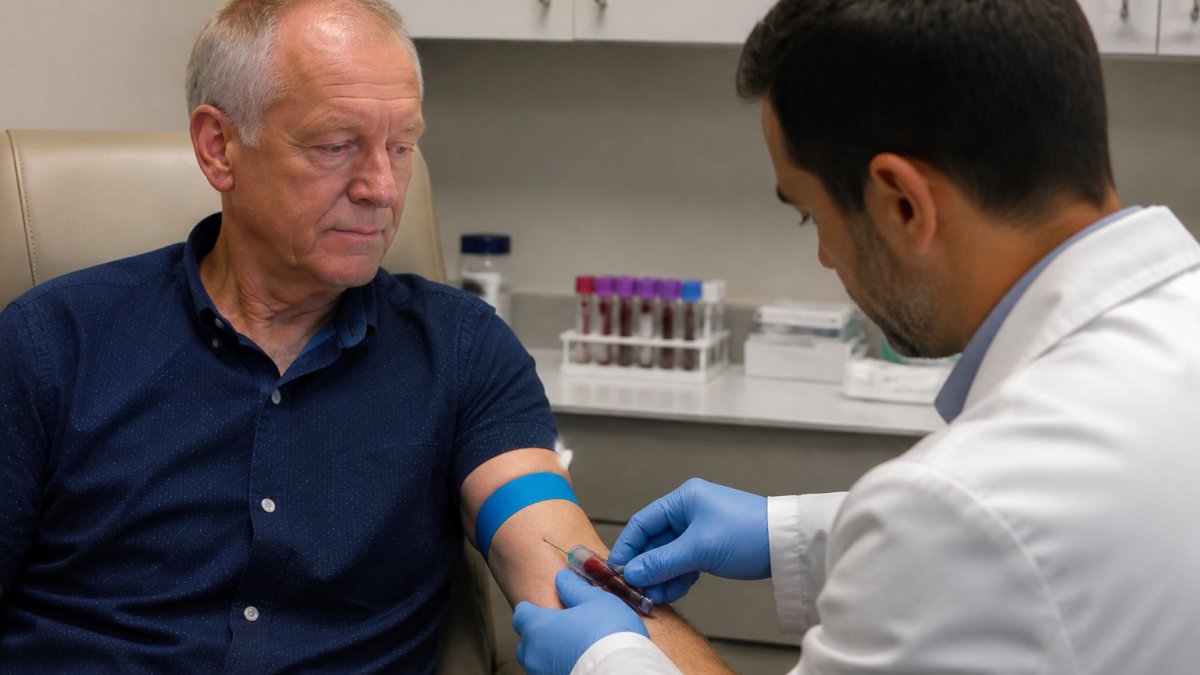
Your doctor will compare your result to the age-adjusted laboratory reference range (typically starting around 300 ng/dL). If your testosterone is below the reference range AND you have symptoms, fatigue, reduced muscle mass, decreased sex drive, or mood changes, hypogonadism is a reasonable diagnosis.
Symptoms alone aren’t enough; fatigue may stem from sleep apnea, thyroid disease, depression, or other causes. Lab testing must confirm low testosterone before considering treatment.
Your doctor should also check for conditions affecting eligibility: prostate exam, cardiovascular history, and screening for contraindications.
Testosterone Therapy and Heart Risk: What You Need to Know
The cardiovascular risk question is the most complicated. Early studies raised concerns about heart attack and stroke risk, but later research has complicated that picture.
Current evidence suggests men with existing cardiovascular disease or significant risk factors face higher risk from testosterone therapy than those without. Age alone doesn’t disqualify you; actual cardiovascular health matters more.
Heart attack, stroke, or unstable angina history generally contraindicates therapy. Well-controlled high blood pressure or stable heart disease may allow therapy with careful evaluation and close monitoring.
The absolute risk of heart attack or stroke in older men receiving testosterone therapy remains uncertain. The decision compares the risks of treatment against the risks of untreated hypogonadism.
Testosterone Therapy Side Effects in Older Men
Common side effects across all formulations:
- Acne or skin irritation (more common with gels and patches applied to skin)
- Fluid retention and mild swelling in the legs or feet
- Breast tenderness or enlargement (gynecomastia)
- Mood changes, including irritability, aggression, or emotional volatility
- Sleep disturbances or insomnia
- Polycythemia (elevated red blood cell count), which thickens blood and increases clot risk
Less common but serious side effects:
- Blood clots and pulmonary embolism (blood clots in the lungs)
- Prostate enlargement or worsening of existing benign prostatic hyperplasia (difficulty urinating, weak stream)
- Worsening of sleep apnea if you already have it
- Liver enzyme changes, though serious liver damage is rare
Intramuscular injections (testosterone cypionate or enanthate, typically 100-200 mg weekly):
- Pros: Once-weekly dosing, stable levels, no skin transfer risk, lowest cost
- Cons: Requires office visits or self-injection training; testosterone fluctuates between injections; some men report mood swings; injection-site pain or bruising
- Monitoring: Testosterone level drawn just before the next injection (trough level)
Transdermal gels (testosterone 1% or 1.62%, typically 50-100 mg daily):
- Pros: Daily application mimics natural rhythm; no injections; flexible dosing
- Cons: Skin irritation; transfer risk to partners or children; higher cost; daily application burden; inconsistent absorption
- Monitoring: Testosterone level drawn 2-4 hours after application (peak level)
Transdermal patches (testosterone 2-6 mg daily):
- Pros: Set-and-forget application; steady delivery; lower transfer risk than gels
- Cons: Skin irritation (common); patches may fall off; higher cost; limited dose flexibility
- Monitoring: Testosterone level drawn 2-8 hours after patch application
Oral testosterone (methyltestosterone or testosterone undecanoate):
- Pros: No injection or skin application; convenient
- Cons: Higher liver enzyme elevation risk; less stable levels; less commonly prescribed due to liver concerns
- Monitoring: Liver function tests required more frequently
Subcutaneous pellets (testosterone implant, 600-1200 mg, replaced every 3-6 months):
- Pros: Infrequent dosing; stable levels; no daily application or injection
- Cons: Requires minor surgical insertion; extrusion or infection risk; difficult to adjust quickly; higher cost; limited availability
- Monitoring: Testosterone level drawn 4-6 weeks after insertion
Testosterone doesn’t cause prostate cancer, but can accelerate growth in men with undiagnosed cancer. Family history of prostate cancer, elevated PSA, or urinary symptoms warrant urologist evaluation. (Source: a 2022 review published in the Journal of the American Medical Association (JAMA))
Blood clots are uncommon but real, especially in older men or those with clot risk factors (obesity, immobility, prior clots, cancer). Polycythemia (elevated red blood cell count) is more common and increases clot risk.
Testosterone can worsen sleep apnea, causing more frequent breathing interruptions and lower oxygen levels. Untreated or severe sleep apnea should be controlled before starting therapy. New or worsening snoring or daytime sleepiness after starting warrants discussion with your doctor.
Choosing a formulation:
Your choice of formulation depends on your preference for convenience, tolerance for skin irritation, ability to attend office visits, cost, and how stable you want your testosterone levels to be.
Testosterone Therapy Monitoring: Tests and Timeline
If you and your doctor decide testosterone therapy is appropriate, ongoing monitoring isn’t optional, it’s essential to catching problems early and adjusting treatment if needed.
Baseline assessment (before starting therapy):
- Testosterone level (morning draw)
- Prostate-specific antigen (PSA) and digital rectal exam
- Complete blood count, including hematocrit (red blood cell percentage)
- Liver function tests (AST, ALT, alkaline phosphatase)
- Lipid panel (total cholesterol, HDL, LDL, triglycerides)
- Cardiovascular history and blood pressure
- Sleep apnea screening (if symptoms present)
Follow-up at 6-8 weeks:
- Testosterone level to confirm the dose is achieving target (typically 400-700 ng/dL, depending on your doctor’s protocol)
- Symptom assessment: fatigue, sexual function, muscle strength, mood
- Side effect check: acne, fluid retention, mood changes, sleep quality
If testosterone is below target, your doctor may increase the dose. If it’s above target or side effects are significant, a dose reduction is common.
Follow-up at 3 months:
- Repeat testosterone level
- Hematocrit check (red blood cell count). Normal hematocrit is roughly 41-50% for men. If yours rises above 54%, your doctor may recommend dose reduction or blood donation to lower the count and reduce clot risk. Elevated hematocrit is one of the most common reasons to pause or adjust therapy.
Follow-up at 6 months:
- Testosterone level
- Complete blood count (hematocrit focus)
- PSA and digital rectal exam
- Liver function tests
- Lipid panel
- Symptom and side effect reassessment
Annual monitoring thereafter:
- Testosterone level
- Complete blood count
- PSA and digital rectal exam (more frequently if PSA is rising or if you have prostate risk factors)
- Liver function tests
- Lipid panel
- Cardiovascular assessment (blood pressure, symptom review, and consideration of stress testing if risk factors are present)
Key decision thresholds:
Hematocrit elevation: If hematocrit climbs above 54%, your doctor will usually recommend dose reduction, switching to a lower-dose formulation, or periodic blood donation (phlebotomy) to maintain a safer level.
Lack of symptom improvement: If after 3-6 months of therapy you don’t feel meaningfully better, fatigue hasn’t improved, sexual function hasn’t changed, muscle strength hasn’t increased, continuing therapy doesn’t make sense.
Liver enzyme elevation: Mild rises in liver enzymes can occur, especially with oral testosterone formulations.
Symptom tracking between visits:
Keep a simple log of how you feel: energy level, sexual function, muscle strength, mood, and any side effects. Testosterone therapy should make you feel noticeably better within 4-12 weeks (Onset of effects of testosterone treatment and time span until maximum effects are…).
Who Should and Shouldn’t Receive Testosterone Therapy
Good candidates for testosterone therapy typically have:
- Confirmed low testosterone (below the normal range for their age)
- Symptoms consistent with low testosterone
- No contraindications like unstable heart disease or a history of blood clots
- Willingness to commit to ongoing lab monitoring
- A realistic understanding of what treatment can and can’t do
Men who should not receive testosterone therapy include those with:
- Untreated or uncontrolled prostate cancer
- A history of blood clots, deep vein thrombosis, or pulmonary embolism
- Severe, untreated sleep apnea
- Unstable angina or recent heart attack
- Severe liver or kidney disease
- Uncontrolled high blood pressure
For men with borderline cardiovascular risk, the decision requires shared decision-making with a physician who understands both your health history and the current evidence. This is where a lab-first approach and ongoing medical support make a difference. At Socal Mens Clinic Virtual, our licensed California physicians work with you to weigh the specific risks and benefits in your situation, not just apply a one-size-fits-all rule.
Age alone, even being over 60 or 70, doesn’t automatically disqualify you. What matters is your actual health status, your testosterone level, your symptoms, and your willingness to stay engaged with monitoring.
Conclusion: Making an Informed Decision
The evidence on testosterone therapy in older men points to a nuanced reality: it can help some men significantly, but it’s not risk-free and it’s not appropriate for everyone. The decision requires honest conversation about your symptoms, your health history, and what the research actually shows, not what marketing claims or internet forums suggest.
If you’re experiencing fatigue, muscle loss, or declining sexual function and you suspect low testosterone might be involved, the first step is a morning blood test to see what your testosterone level actually is. From there, a physician can help you understand whether treatment makes sense for your situation and what monitoring looks like if you decide to move forward.
Frequently Asked Questions
What should a 70-year-old man’s testosterone level be?
Testosterone levels decline naturally with age. A typical reference range for adult men is 300 to 1000 ng/dL, though this range can vary by lab. For older men, the reference range often remains the same, but a morning blood test is essential because testosterone levels fluctuate throughout the day. A diagnosis of low testosterone (hypogonadism) is made when levels fall below the lab’s reference range AND symptoms are present. Your physician should interpret your results in context of your symptoms, not age alone.
Can a 75-year-old man take testosterone therapy?
Age alone does not disqualify a man from testosterone therapy. However, a 75-year-old requires careful medical evaluation by a qualified physician. A confirmed diagnosis of low testosterone, absence of contraindications (such as untreated prostate cancer or severe sleep apnea), and ongoing medical supervision are essential. Existing health conditions, heart disease, blood clots, or enlarged prostate, may affect eligibility. A thorough medical evaluation and shared decision-making with your physician are necessary to determine whether treatment is appropriate for your individual situation.
Does testosterone therapy increase the risk of heart problems?
Testosterone therapy and heart risk remain areas of ongoing research with conflicting findings. Some clinical studies suggest increased cardiovascular risk, particularly in older men or those with existing heart disease, while other research shows less clear associations. Risks may include heart attack, stroke, or blood clots. Men with a history of heart disease, heart attack, or stroke should discuss this risk carefully with their physician before starting treatment. Ongoing monitoring and regular follow-up are important to assess treatment response and watch for adverse effects.
What monitoring is needed during testosterone therapy?
Regular monitoring is essential for safety. Your physician should order repeat blood tests to check testosterone levels, typically 6-8 weeks after starting therapy, then periodically thereafter. Prostate health should be assessed, including PSA testing and digital rectal exam as appropriate. Cardiovascular health requires monitoring, especially in older men. Red blood cell counts need checking, as testosterone can increase them. Your physician should also assess symptom improvement and any adverse effects. A lab-first approach using established testing ensures your treatment is personalized and safe.
At Socal Mens Clinic Virtual, we help men navigate this decision with a lab-first approach and ongoing medical support from licensed California physicians. Our virtual telehealth platform makes it easy to get tested, discuss results, and stay monitored without the complexity of insurance. If you’re ready to understand your testosterone levels and explore whether therapy might help you reclaim your energy and performance, get started with a consultation today.