
Table of Contents
- What to Expect During a TRT Consultation: The Full Walkthrough
- TRT Consultation Preparation: What to Bring and How to Get Ready
- Symptom Review: Energy, Mood, Sleep, and Sexual Health
- Medical History, Medications, and Physical Examination
- TRT Blood Work: Morning Draws, Lab Results, and Repeat Testing
- TRT Eligibility: Who Qualifies and Who Should Wait
- Questions to Ask About TRT Before You Start
- Conclusion
- Frequently Asked Questions
Last Updated: October 17, 2026
What to Expect During a TRT Consultation: The Full Walkthrough
A TRT consultation is a medical evaluation, not a prescription handoff. It usually runs 20 to 30 minutes and covers your symptoms, history, an exam, and a plan for blood work. At Socal Mens Clinic Virtual, we run this visit over a secure video call, and the goal is the same as any in-person appointment: figure out whether low testosterone is actually your problem before anyone writes a prescription.
Here’s the honest part most guides skip. A single office visit cannot diagnose low testosterone. Symptoms alone are unreliable, and one blood draw is often not enough. The consultation is the start of a process, not the finish line.
Below, we’ll walk you through each stage of a TRT consultation so you know what’s coming, what to bring, and what questions to ask before you commit to anything.
TRT Consultation Preparation: What to Bring and How to Get Ready
Good TRT consultation preparation takes about 20 minutes and makes the whole visit sharper. Show up unprepared and you’ll spend half the appointment trying to remember when your fatigue started.
Bring these to the call:
- A written symptom list with rough start dates
- Every medication you take, including supplements
- Prior lab results, if you have them
- Your insurance card, even if you’re paying cash
- A list of your top three questions
Timing matters too. Testosterone peaks in the morning, so a morning blood draw gives the cleanest reading. If your visit is virtual, find a private room and a stable connection before you dial in.
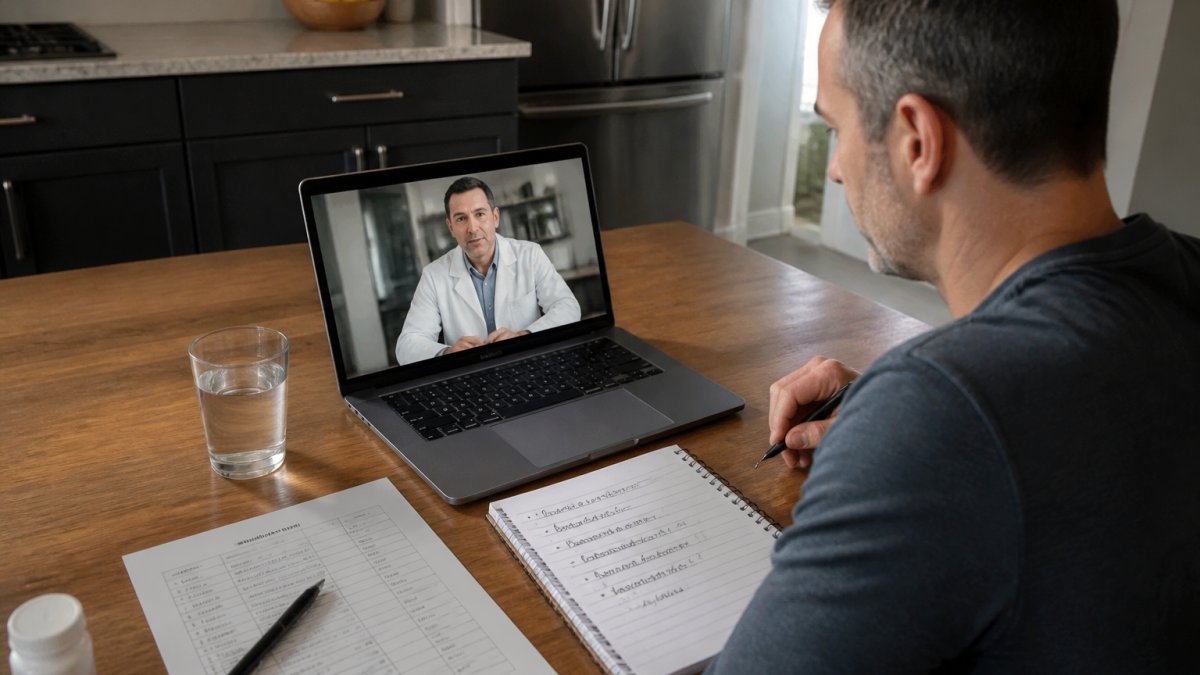
Write your symptom timeline before the call, not during it. Note when fatigue, low libido, or sleep problems started, and whether anything changed around that time (a new job, a medication, a weight shift). Providers use that timeline to separate hormonal causes from lifestyle ones.
Symptom Review: Energy, Mood, Sleep, and Sexual Health
The symptom review is the longest part of the visit. Expect direct questions about energy levels, fatigue, sleep quality, mood, concentration, and sexual health, including libido and morning erections.
Answer honestly, even when it’s uncomfortable. Providers aren’t judging you; they’re building a differential. Low testosterone overlaps heavily with depression, sleep apnea, thyroid problems, and plain old burnout. Your answers help rule those out.
A few things to flag specifically:
- Strength and body fat changes over the past year
- Whether symptoms came on gradually or suddenly
- Any recent major stress or life change
Don’t exaggerate symptoms to speed up a prescription. Clinics that hand out testosterone based on a questionnaire alone put you at real risk, and a provider who skips the workup is not doing you a favor.
Medical History, Medications, and Physical Examination
Your medical history decides whether treatment is even on the table. Expect questions about heart disease, blood clots, prostate issues, sleep apnea, and any prior hormone use.
Medications matter just as much. Opioids, steroids, and some antidepressants can suppress testosterone. So can heavy alcohol use. Bring the full list, including anything you buy over the counter.
The physical examination depends on the format. In person, it typically includes blood pressure, weight, and a focused exam. Over telehealth, your provider may ask you to report recent readings or arrange a local exam. Either way, this step screens for conditions that make testosterone risky.
TRT Blood Work: Morning Draws, Lab Results, and Repeat Testing
TRT blood work is where the real diagnosis happens, and it is also where most online guides get vague. A total testosterone level drawn in the morning is the standard starting point, but your provider should review it alongside symptoms, timing, and a second confirmatory draw, not in isolation.
Why timing and assay choice matter
Testosterone follows a daily rhythm. Levels are highest in the morning and fall through the afternoon, which is why a morning draw (typically before 10 a.m.) gives the cleanest reading. A 3 p.m. sample from a tired patient can look low even when morning levels are normal. Your provider should also tell you which assay was used: total testosterone, free testosterone, or both. Total testosterone is the usual first-line test; free testosterone is sometimes added when total levels are borderline or when a binding-protein issue is suspected.
How results are actually interpreted
There is no single cutoff that diagnoses low testosterone on its own. Most practitioners treat the decision as a pattern: consistently low morning total testosterone readings combined with matching symptoms. Common reference ranges sit roughly in the 300-1,000 ng/dL band for total testosterone, but labs set their own ranges, and a number just under 300 is not automatically a diagnosis, nor is a number just over it automatically normal. That is why clinicians look at the trend across tests, the time of draw, and the symptom picture together.
A typical workup also includes:
- Complete blood count (to check hematocrit and hemoglobin)
- Prostate-specific antigen (PSA) at baseline
- Liver and kidney function
- Lipid panel
- Sometimes LH and FSH to distinguish testicular from pituitary causes
Why repeat testing is standard
One low reading does not confirm anything. Levels fluctuate with sleep, stress, illness, weight change, and even the previous night’s alcohol intake. A single draw can land low for reasons unrelated to a deficiency. That is why repeat testing is common: a second morning draw, often two to four weeks later and sometimes with additional markers, gives a far more reliable picture. If the two draws disagree, a third may be ordered before any treatment decision.
What to ask for
Ask your provider to walk you through the lab results in plain language: which markers were run, where your numbers fall relative to the lab’s range, and how those numbers connect back to your symptoms. Request a copy of the results for your records. If a clinic is willing to prescribe based on a single questionnaire or a single draw, that is a signal the workup is being shortcut.
If you have prior labs from another provider, bring them. A trend across two or three draws over several months is more informative than any single number, and it can save you a repeat visit.
TRT Eligibility: Who Qualifies and Who Should Wait
TRT eligibility comes down to three things: consistent low readings, matching symptoms, and no contraindications. Miss any one of those and a careful provider will pause. Most guides stop there. The part they skip is the list of conditions, medications, and alternative explanations that decide whether treatment is safe and appropriate for you specifically.
Who may be a candidate
You may be a candidate if you have:
- Low testosterone on more than one morning test
- Symptoms that line up with the numbers (fatigue, low libido, mood changes, reduced muscle mass)
- No history of prostate cancer or uncontrolled heart conditions
Contraindications and precautions
Some conditions make testosterone therapy risky or off-limits until they are addressed. These include:
- Prostate cancer or a history of it
- Breast cancer
- Uncontrolled heart failure or recent heart attack
- Untreated severe sleep apnea
- Elevated hematocrit or a history of blood clots
- Active or recent desire to conceive (see below)
Your provider should also review medications that can suppress testosterone or interact with treatment: opioids, glucocorticoids, some antidepressants, and certain antipsychotics are common examples. Heavy alcohol use and anabolic steroid use belong in the same conversation.
Alternative causes of symptoms
Low testosterone overlaps heavily with other problems, and a good consultation rules them out before treatment. Poor sleep and sleep apnea, depression, thyroid dysfunction, anemia, chronic stress, and significant weight change can all produce the same fatigue and low libido. If your symptoms point elsewhere, the right next step may be a sleep study, a thyroid panel, or a mental health referral, not testosterone.
Fertility and family planning
This is the conversation most guides omit. Testosterone therapy can suppress sperm production, sometimes to zero, and that effect is not always fully reversible. If you and a partner hope to conceive in the next few years, raise it before treatment starts. Alternatives such as clomiphene or hCG may be discussed, and sperm banking is an option some men choose before beginning therapy.
Patient rights and pressure to start
A consultation is an evaluation, not a guaranteed prescription. You are entitled to a clear explanation of why treatment is or is not recommended, a copy of your labs, and a second opinion if you want one. Shared decision-making means the plan reflects your goals, including fertility plans and cost, not just a lab number.
A good clinic says no sometimes. If a provider offers testosterone without repeat labs, a real symptom review, or a conversation about fertility and contraindications, that is a red flag, not convenience.
Questions to Ask About TRT Before You Start
The best questions to ask about TRT are the ones that force specifics. Vague answers mean vague care.
Ask these:
- What were my exact levels, and how many tests confirmed them?
- What are the benefits and risks for someone with my history?
- Which treatment options fit me, and why?
- How will you monitor me, and how often?
- What happens if it doesn’t work?
Also ask about cost and coverage. Insurance handling varies, and you deserve a straight answer on what you’ll pay before you start.
Conclusion
The biggest challenge with a TRT consultation isn’t the appointment itself. It’s finding a provider who runs the full workup instead of skipping straight to a prescription. That’s exactly how we built our process at Socal Mens Clinic Virtual: licensed California physicians, a lab-first approach using LabCorp, and 100% virtual visits with no insurance needed. Ongoing medical support is built into every plan, so your labs and symptoms get reviewed as you go. Get started with Socal Mens Clinic Virtual and walk into your consultation knowing exactly what to expect.
Frequently Asked Questions
What happens during a TRT consultation?
A TRT consultation is a structured evaluation, not a prescription handoff. The provider reviews your symptoms (energy, mood, sleep, libido, focus, strength), takes your medical history and current medications, and discusses any prior labs. A physical examination or in-person referral may follow. Most visits run about 20 to 30 minutes, in person or by video. TRT blood work usually comes next: a morning draw, provider review of results, and sometimes repeat testing before any diagnosis or treatment decision is made.
Do I need TRT blood work before a TRT consultation?
Bring any labs you already have, including results your regular doctor called normal. They give the provider a baseline and a starting point. That said, most clinics order their own TRT blood work because timing matters: testosterone peaks in the morning, so a morning blood draw gives the most reliable reading. Repeat testing is common because a single low result is not enough to confirm low testosterone. Expect total and free testosterone, plus related markers, before any prescription is discussed.
What should I bring to my first TRT appointment?
Bring a list of current medications and supplements, your medical history (including prior testosterone results), insurance card if applicable, and a written list of symptoms with rough start dates. Note sleep quality, libido changes, morning erections, mood, and focus, since a symptom timeline helps the provider judge whether the pattern fits low testosterone. Add your questions to ask about TRT so you do not leave without answers on cost, monitoring, fertility, and follow-up.
What happens if my testosterone levels are normal?
A normal result is useful information, not a dead end. Low testosterone symptoms like fatigue, brain fog, and low libido overlap with thyroid problems, sleep apnea, depression, anemia, and medication side effects, so the provider looks at alternative causes. If levels sit in a borderline range, repeat testing at an early morning draw can clarify the picture. TRT eligibility depends on symptoms plus consistently low labs, not a single number, and treatment is not appropriate when levels are normal.