
Quick Summary
Portion control means eating an amount of food that matches what your body actually needs, and it is the most direct lever for weight management, energy, and muscle maintenance. Use the plate method: fill half your plate with vegetables, a quarter with lean protein, and a quarter with starch.
- Start with roughly 120 to 180 grams of cooked lean protein per meal, scaled to your body size and activity.
- Use a standard 10-inch dinner plate rather than an oversized one to keep portions in check.
- Build buffet plates in order: vegetables first, then protein, then starch.
- Split takeout meals into a serving for now and store the rest before you start eating.
- Aim to stop eating around seven or eight on a ten-point hunger scale, satisfied but not stuffed.
Table of Contents
- Why Portion Control Matters More for Men
- Portion Sizes in Grams for Weight Loss and Muscle Gain
- A Portion Control Chart and Plate Method Men Can Follow
- Booking a Plan Built Around Your Labs and Goals
- Frequently Asked Questions
Why Portion Control Matters More for Men
Portion control means eating an amount of food that matches what your body actually needs. For many men, it is the most direct lever for weight management, energy, and muscle maintenance.
Last Updated: November 16, 2026
Men often carry more muscle and burn more energy than women, so their calorie needs are usually higher, which also makes oversized meals easy to justify. Learn more about natural ways to raise testosterone for more energy. Men who eat well by most standards can still struggle with fatigue and a stubborn waistline. Often the issue is portion size. Large restaurant plates, takeout, and second helpings add up quickly, and hunger and fullness signals can get out of step. Portion control does not mean eating less food overall. It means matching each meal to your goals.
Portion Sizes in Grams for Weight Loss and Muscle Gain
Portion size and serving size are not the same. A serving is the standard amount on a nutrition label; a portion is how much you put on your plate. For most men the label serving is a starting reference, not a rule.
Use grams or a food scale when you want precision. A general starting point for a moderately active man:
- Lean protein: roughly 120 to 180 grams cooked per meal
- Starchy carbs like rice or potatoes: about 150 to 200 grams cooked per meal
- Vegetables: at least one generous fist-sized portion per meal
- Healthy fats: a thumb-sized amount, roughly 10 to 15 grams
Those ranges are a starting point, not a prescription. A 6-foot-2 man who lifts four days a week usually needs more protein and carbohydrate than a 5-foot-7 desk worker. Anchor your portions to your body size and activity level, then adjust.
Start with protein. Protein needs are often discussed in terms of body weight, and a common range used in sports nutrition is roughly 1.6 to 2.2 grams per kilogram per day, split across three or four meals. A clinician can help determine what suits your situation.
Carbohydrate portions should track your training: keep starch closer to the higher end on lifting or hard conditioning days, and pull it back on rest days while vegetables and protein fill the plate. Fat portions stay steady because fat is calorie-dense and easy to over-pour.
Men focused on muscle gain often need more protein and carbohydrate and a slight calorie surplus; men focused on fat loss may need smaller starch portions and a slight deficit, but should keep protein high to protect muscle. If strength is holding or climbing and your waist is stable, your portions are close. If strength is dropping and fatigue is rising, you have likely cut too far.
Watch out: weighing every bite indefinitely can turn portion control into rigid calorie restriction. Use the scale as a short-term calibration tool, then transition to visual estimates once your eye is trained.
The article gives starting portion ranges per meal, which are summarised below.
| Food group | Starting portion per meal | Note |
|---|---|---|
| Lean protein | 120 to 180 g cooked | Scale to body size and activity |
| Starchy carbs | 150 to 200 g cooked | Higher on training days |
| Vegetables | One generous fist-sized portion | At least one per meal |
| Healthy fats | 10 to 15 g (thumb-sized) | Calorie-dense, easy to over-pour |
A Portion Control Chart and Plate Method Men Can Follow
The plate method is a simple, visual way to build balanced meals without measuring every bite. You can also see a sustainable weight loss plan built for busy men that puts this method into a practical routine. Fill half your plate with vegetables, one quarter with lean protein, and one quarter with whole-grain carbs or starchy foods.
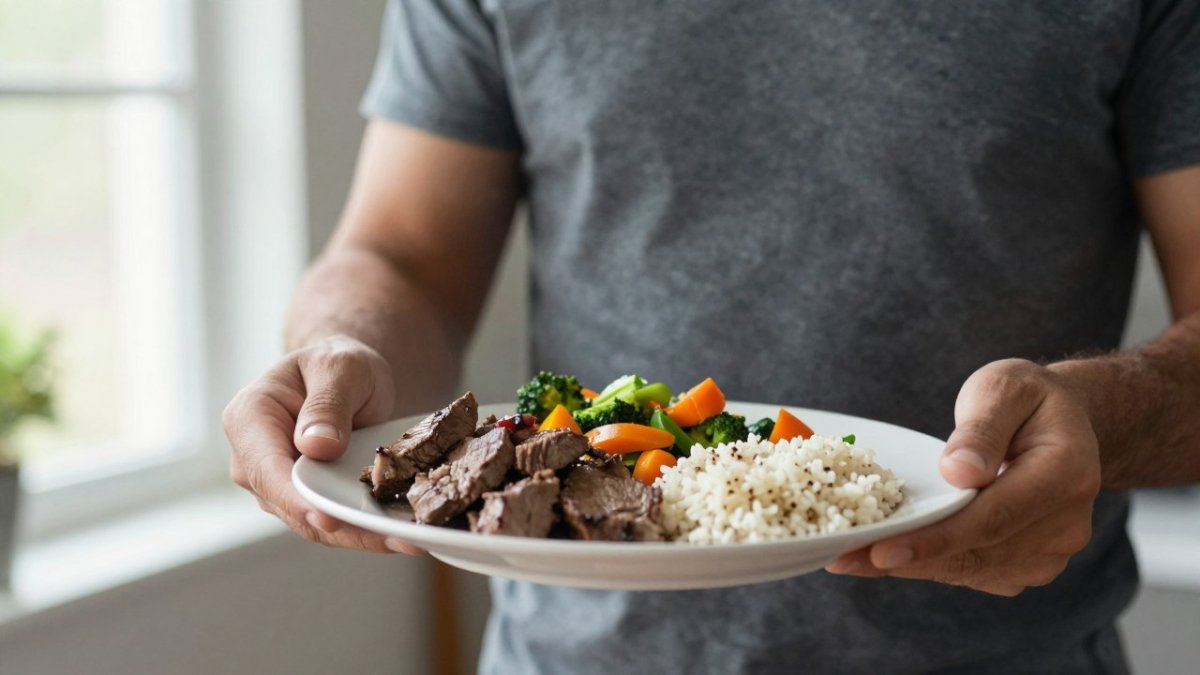
Use a standard 10-inch dinner plate rather than an oversized one. Smaller plates make portions look fuller and help you eat less without feeling deprived.
- Half the plate: non-starchy vegetables
- One quarter: lean protein such as chicken, fish, or lean beef
- One quarter: rice, potatoes, or whole grains
- Add a thumb-sized amount of healthy fat, like olive oil or nuts
Keep a chart on your fridge at eye level where you serve food for a few weeks until the proportions feel automatic.
The harder part is applying the plate method where portions actually go wrong. At a work lunch or catered meeting, build your plate in this order: vegetables first, then protein, then starch. Buffet lines and sandwich trays push starch and fat, so filling the vegetable half first leaves less room for the rest. If the only options are heavy, take half of what you normally would and plan a protein-rich snack for the afternoon.
With takeout, split the container before you sit down. Restaurant and takeout meals are often two or more servings, so put half on a plate and store the rest before you start eating. This one habit does more for portions than any chart.
At buffets and social events, use a smaller plate if one is available, make one pass through the line, and sit away from the food. Standing near the buffet is the biggest driver of second and third helpings.
For late-night eating, ask whether you are hungry or tired. If genuinely hungry, a measured portion of protein and produce, a fist of leftovers or a cup of Greek yogurt with fruit, beats grazing from a bag or box. Eating from the container is the most common way portions quietly double. For snacks, serve them into a bowl or onto a plate rather than eating from the package. A closed bag is a portion; an open bag is a bottomless one.
Pair the plate method with hunger and fullness cues so portion control does not become rigid restriction. Rate your hunger from one to ten before a meal and aim to stop around seven or eight, satisfied but not stuffed. Routinely finishing at nine or ten means portions are too large; finishing at four means they are too small.
Track progress over time rather than day to day. Weigh yourself a few times a week under the same conditions, note energy and hunger between meals, and check whether strength is holding in the gym. If weight is flat and energy is good, your portions are working. If weight is climbing, trim the starch portion slightly. If weight is dropping faster than you want or hunger is distracting, add back a portion of protein or produce. Adjust one variable at a time and give each change two to three weeks.
Booking a Plan Built Around Your Labs and Goals
Portion needs are personal. Your energy, muscle mass, hormone levels, and medical history all affect what the right amount looks like for you. If you want individualized guidance, our medical weight loss service can be a good place to start, and our guide on how to interpret your Labcorp blood test results explains what your bloodwork can show. Before you commit, review what to expect during a TRT consultation so you know what the first visit involves.
Frequently Asked Questions
Can portion control help with weight loss?
Yes. Portion control helps most when it keeps daily calorie intake below what your body uses. Many men eat larger servings than they realize, especially at restaurants and with takeout, so measuring protein, starches and fats for a few weeks can show where extra calories come from. Pair portions with regular physical activity and protein at each meal to stay full. Your own energy needs depend on body size, activity and health history, so a clinician can help set a target that fits you.
How can men estimate portion sizes without a food scale?
A practical method uses your hand: a palm of protein is roughly a serving, a fist of vegetables or fruit, a cupped hand of starch, and a thumb of fat. These are estimates, not exact measurements, so checking with a measuring cup or food scale for a week can help calibrate your eye. Eating slowly and stopping when you feel satisfied, not stuffed, also helps portions stay in range over time.
What is the difference between a serving size and a portion?
A serving size is the amount listed on a nutrition label, such as one cup of cooked pasta. A portion is the amount you actually put on your plate, which may be two or three servings. Comparing the two on the nutrition label helps you see how much you are really eating. Use the label as a reference point and adjust your plate to match your personal goals.